

Introduction
Global advertising crossed the $1 trillion mark in 2024, according to WARC's Global Ad Spend Outlook, and a meaningful slice of it goes nowhere. A widely cited 2018 Rakuten Marketing survey found marketers estimated 26% of budgets were wasted on ineffective channels and strategies.
The reason waste compounds is timing. Budget overruns, suppressed ROAS, and missed targets don't appear overnight, and by the time a weekly report surfaces an underperforming cell, the money is already spent. The fix isn't another manual audit or a longer paid-media checklist. It's spend intelligence that scores performance nightly and reallocates budget before the next day is committed.
This article shows what that intelligence layer does, then walks the six places ad budget leaks and how automated scoring catches each one.
Key Takeaways
- The waste that matters is invisible at the campaign level; it only surfaces in ROAS weeks later, after the budget is gone
- Weekly reporting is too slow: by the time a report flags a bad cell, the spend has already happened
- Spend intelligence closes that gap, scoring every ad set nightly on incremental return, detecting creative fatigue on Day 2, and ranking the next reallocation move
- The six common leak points, from undefined goals to fragmented data, are all sources the nightly scoring detects and acts on
- The motion is Grow: rank the next best spend action, execute it, and learn from the outcome
Spend Intelligence: What Actually Cuts the Waste
Diagnosing waste is the easy half. The hard half is that by the time a weekly report identifies an underperforming cell, the money is already spent. Spend intelligence closes that gap by making the decision nightly rather than weekly:
- Nightly incremental ROAS scoring. Every ad set is scored on incremental return, not last-click attribution, so cells that only look profitable because they harvest existing demand stop absorbing budget.
- Creative fatigue detection on Day 2. Fatigue is caught from the curve shape as it starts, not from a month-end review after the creative has already stopped working.
- Ranked reallocation recommendations. The output is not a dashboard. It's an ordered list of moves, each with the reasoning attached, that a growth lead can approve in the morning.
At an airline deployment, this moved reallocation latency from 48 to 72 hours down to 4 hours. Blended cost per install fell 26%, D30 return on ad spend moved from 0.78 to 1.14, spend sitting in underperforming cells dropped from 24% to 8%, and creative fatigue was caught on Day 2 instead of Day 6.
The agents read attribution, telemetry, and payment data read-only, inside the business's own environment. Nothing is written back to the ad platforms without an approved, audited action.
How Wasted Ad Spend Builds Up
Ad waste rarely shows up as one obvious line item. It accumulates in parallel: impressions reaching the wrong users, clicks that don't convert, and retargeting ads served to customers who already bought last week.
At the campaign level it's hard to spot; it usually surfaces only when you analyze ROAS across a longer window, by which point weeks of budget have already been burned. That invisibility is exactly why scoring nightly, rather than weekly, is the difference between catching waste and paying for it.
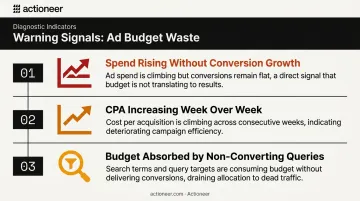
Three patterns signal that waste is accumulating:
- Spend is up but conversion volume isn't growing proportionally
- Cost per acquisition is rising week over week without a clear trigger
- Search term reports show budget absorbed by queries that don't convert
6 Critical Reasons Your Ad Budget Gets Wasted
Each of these is a real leak, and each is a signal the nightly scoring is built to catch.
Reason 1: Vague Campaign Goals and Undefined Success Metrics
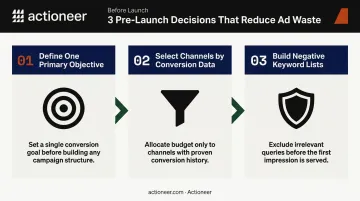
Campaigns without a clearly defined objective default to platform-optimized delivery. Platforms are good at optimizing toward a signal, but if you haven't told them what signal matters, they'll optimize toward whatever's easiest to measure. That's often impressions or clicks, not conversions or revenue. Teams end up reporting on CTR while the business tracks cost per lead: the metrics look fine, and the budget erodes with nothing to show for it.
How the scoring catches it: Because every ad set is scored on incremental return rather than whatever the platform finds easiest to optimize, cells chasing cheap impressions or clicks instead of revenue surface immediately, before a month of budget follows the wrong signal.
Reason 2: Broad Keyword Targeting Without Negative Keywords
Broad match keywords trigger ads for searches that share loose semantic similarity with your target terms. That's useful for reach; it's expensive when your ad for "business insurance" appears for "insurance agent jobs." Seer Interactive's analysis across 30 paid search accounts found that 15% of paid search budget was wasted on irrelevant keywords on average, and WordStream's Google Ads performance study shows low-converting accounts consistently had fewer negative keywords than high-converting ones.
How the scoring catches it: Nightly incremental scoring flags queries and cells absorbing budget without producing incremental return and ranks them for exclusion, so the waste window is a night, not a quarter.
Reason 3: Audience Targeting Built on Stale Data
Marketing databases degrade by roughly 22.5% per year, according to HubSpot's database decay simulation, and Salesforce research puts contact databases at 90% incomplete on average, with 20% of records actively useless. When targeting is built on stale exports, you pay to reach users whose behavior or purchase history has changed, and the clearest case is retargeting served to customers who converted days ago.
How the scoring catches it: The agents read live attribution and CRM signals, so customers who already converted drop out of active spend automatically, with no wait on a manually refreshed exclusion list.
Reason 4: Creative Fatigue
When the same ad reaches the same user repeatedly, performance deteriorates. Meta defines creative fatigue as reduced performance from repeated exposure to identical creative, and its analytics research found addressing fatigue improved conversion rates by 8% on average in high-fatigue cases. Rising frequency without rotation inflates cost per result even when targeting stays constant: the audience hasn't changed, engagement has dropped, and the platform keeps spending.
How the scoring catches it: Fatigue is detected from the curve shape on Day 2 and the swap is ranked for approval, instead of waiting for CTR to fall and a manual refresh cycle to catch up.
Reason 5: Landing Page Experience That Breaks the Post-Click Journey
You can have the right audience, keyword, and bid and still waste the click if the landing page doesn't match the ad. Google's Ads Help documentation connects keyword, ad, and landing page alignment to conversion probability, and a Google/Deloitte study found a 0.1-second improvement in mobile page speed lifted retail conversion rates 8.4% and travel 10.1%.
How the scoring catches it: When post-click conversion decays, incremental scoring pulls budget off the affected cells and ranks the reallocation, so a broken downstream experience stops draining spend while the page is being fixed.
Reason 6: Fragmented Data Infrastructure That Delays Optimization Signals
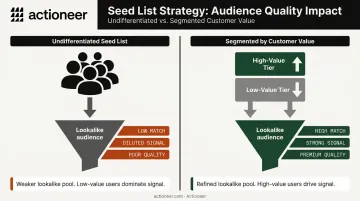
When CRM data, ad platform pixels, and behavioral analytics sit in silos, the delay between a conversion event and the matching optimization can be significant. Google documents that conversion statistics can take up to 48 hours to appear, and the Salesforce State of Marketing identifies unifying customer data from disparate sources as a major ongoing hurdle. Until that unification happens, converted customers stay in active retargeting, lookalike models get seeded with low-value buyers, and underperforming segments keep receiving spend because the signal hasn't reached the optimizer.
How the scoring catches it: The intelligence layer unifies attribution, telemetry, and payment data read-only in one place, closing the signal lag so reallocation happens nightly instead of 48 hours after the conversion.
From Reasons to Action: The Grow Motion
Diagnosis alone doesn't recover budget; action does. The Grow motion turns each of the six signals into a decision: rank the next best spend action, execute it under an approved and audited change, and learn from the outcome so the next night's scoring is sharper. Run nightly, that loop is what moves reallocation from a weekly meeting to a morning approval, and it's why the waste is caught in a day rather than a quarter.
Conclusion
Wasted ad spend isn't cut by auditing harder; it's cut by shortening the loop between a signal and the reallocation it should trigger. Goals shift, audiences go stale, creative fatigues, and data gaps widen, but when every ad set is scored nightly and the next move is ranked and ready, waste gets caught in a day instead of a quarter.
Governance, compliance, and security are properties of the platform rather than a separate product you buy alongside it. Actioneer is certified to SOC 2 Type 2, ISO/IEC 27001:2022, and ISO/IEC 27701:2019, with GDPR and HIPAA alignment. The full control set is documented on our Trust and Security page.
If you want to see what this looks like against your own data, book a discovery conversation at actioneer.com/book. The build is team carried and takes under 25 hours of client IT time. What drives the timeline is how many source systems need connecting and whether the environment is cloud or on premise.
Frequently Asked Questions
How much ad spend is wasted?
Industry estimates vary, but a Rakuten Marketing survey found marketers believed roughly 26% of marketing budgets were wasted on ineffective channels, and that was before programmatic complexity increased. The actual figure depends on targeting maturity, channel mix, and how well CRM and ad platform data are connected.
How can I reduce wasted ad spend?
The fastest lever is shortening the loop between a signal and the action it should trigger: score ad sets nightly on incremental return, detect creative fatigue early, and reallocate before the next day's budget commits, rather than relying on periodic manual audits.
What is a good ROAS for digital advertising?
ROAS benchmarks vary significantly by channel, industry, and margin structure; there's no universal threshold across paid search, paid social, and display. What matters more is the trend: a declining ROAS is usually a symptom of one or more of the six waste reasons covered here, not a standalone metric to optimize on its own.
How do I know if my campaigns are generating wasted ad spend?
Watch for these diagnostic signals:
- High spend with low conversion volume
- Rising cost per acquisition over time
- Search term reports showing irrelevant queries
- Retargeting ads served to already-converted customers
These signals tend to cluster when multiple waste reasons are active at once.